In a 1925 Survey Conducted in Muncie Indiana Most of the Families Who Owned Cars Did Not Have
© AP
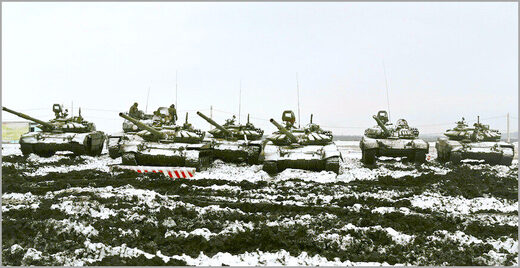
Russian tanks in drills at the Kadamovskiy firing range in the Rostov region in southern Russia
Jan. 12, 2022
In a recent press conference held on the occasion of a visit to Moscow by Hungarian Prime Government minister Viktor Orban, Russian President Vladimir Putin spoke nearly continued NATO expansion, and the potential consequences if Ukraine was to join the trans-Atlantic alliance. He said:
"Their [NATO's] main task is to contain the evolution of Russia. Ukraine is just a tool to attain this goal. They could draw us into some kind of armed conflict and strength their allies in Europe to impose the very tough sanctions that are beingness talked about in the United States today. Or they could draw Ukraine into NATO, gear up strike weapons systems there and encourage some people to resolve the event of Donbass or Crimea by strength, and however draw us into an armed conflict."
Putin continued:
"Permit us imagine that Ukraine is a NATO member and is stuffed with weapons and there are land-of-the-art missile systems but like in Poland and Romania. Who will end it from unleashing operations in Crimea, permit alone Donbass? Let us imagine that Ukraine is a NATO member and ventures such a combat functioning. Do we have to fight with the NATO bloc? Has anyone thought anything about information technology? It seems not."
Simply these words were dismissed by White House spokesperson Jen Psaki, who likened them to a fox "screaming from the top of the hen firm that he'southward scared of the chickens," adding that any Russian expression of fearfulness over Ukraine "should non exist reported as a statement of fact."
Psaki's comments, nevertheless, are divorced from the reality of the situation. The primary goal of the government of Ukrainian President Volodymyr Zelensky is what he terms the " de-occupation" of Crimea. While this goal has, in the past, been couched in terms of diplomacy - "[t]he synergy of our efforts must forcefulness Russia to negotiate the return of our peninsula," Zelensky told the Crimea Platform, a Ukrainian forum focused on regaining control over Crimea - the reality is his strategy for return is a purely armed services one, in which Russian federation has been identified as a "military adversary", and the accomplishment of which tin only be achieved through NATO membership.
How Zelensky plans on accomplishing this goal using military machine means has not been spelled out. Every bit an ostensibly defensive alliance, the odds are that NATO would not initiate any offensive military action to forcibly seize the Crimean Peninsula from Russia. Indeed, the terms of Ukraine'due south membership, if granted, would need to include some linguistic communication regarding the limits of NATO'southward Article 5 - which relates to collective defence - when addressing the Crimea state of affairs, or else a state of war would de facto be upon Ukrainian accretion.
The most probable scenario would involve Ukraine being rapidly brought under the 'umbrella' of NATO protection, with 'battlegroups' like those deployed into eastern Europe being formed on Ukrainian soil as a 'trip-wire' force, and modern air defenses combined with forward-deployed NATO shipping put in identify to secure Ukrainian airspace.
Once this umbrella has been established, Ukraine would feel emboldened to begin a hybrid conflict confronting what it terms the Russian occupation of Crimea, employing anarchistic warfare capability information technology has acquired since 2015 at the hands of the CIA to initiate an insurgency designed specifically to "impale Russians."
The idea that Russia would sit down idly by while a guerilla state of war in Crimea was being implemented from Ukraine is ludicrous; if confronted with such a scenario, Russia would more than than likely use its ain anarchistic capabilities in retaliation. Ukraine, of course, would weep foul, and NATO would be confronted with its mandatory obligation for commonage defense under Article 5. In curt, NATO would be at state of war with Russia.
This is not idle speculation. When explaining his recent determination to deploy some 3,000 Usa troops to Europe in response to the ongoing Ukrainian crisis, United states President Joe Biden declared:
"As long every bit he's [Putin] acting aggressively, we are going to make sure we reassure our NATO allies in Eastern Europe that we're there and Article five is a sacred obligation."
Biden's comments echo those made during his initial visit to NATO Headquarters, on June 15 last year. At that time, Biden sat down with NATO Secretary-General Jens Stoltenberg and emphasized America'due south commitment to Article 5 of the NATO charter. Biden said:
"Article 5 we take every bit a sacred obligation. I want NATO to know America is there."
Biden's view of NATO and Ukraine is drawn from his experience as vice president under Barack Obama. In 2015, then-Deputy Secretary of Defense Bob Piece of work told reporters:
"As President Obama has said, Ukraine should ... be able to choose its own hereafter. And nosotros reject any talk of a sphere of influence. And speaking in Estonia this by September, the president fabricated information technology articulate that our delivery to our NATO allies in the face of Russian aggression is unwavering. As he said it, in this alliance in that location are no old members and there are no new members. In that location are no junior partners and there are no senior partners. There are but allies, pure and simple. And we volition defend the territorial integrity of every single ally."
Merely what would this defence force entail? As someone who once trained to fight the Soviet Army, I can attest that a war with Russia would exist different anything the US military has experienced - ever. The Usa military is neither organized, trained, nor equipped to fight its Russian counterparts. Nor does it possess doctrine capable of supporting large-calibration combined arms conflict. If the U.s.a. was to be drawn into a conventional footing war with Russia, it would find itself facing defeat on a scale unprecedented in American military machine history. In short, it would be a rout.
Don't accept my word for it. In 2016, then-Lieutenant General H.R. McMaster, when speaking about the results of a study - the Russia New Generation Warfare - he had initiated in 2015 to examine lessons learned from the fighting in eastern Ukraine, told an audience at the Center for Strategic and International Studies in Washington that the Russians have superior artillery firepower, meliorate combat vehicles, and have learned sophisticated use of unmanned aerial vehicles (UAVs) for tactical effect.
"Should US forces find themselves in a country war with Russian federation, they would be in for a rude, cold enkindling."
In brusk, they would get their asses kicked.
America'south 20-year Middle Eastern misadventure in Afghanistan, Iraq, and Syria produced a military machine that was no longer capable of defeating a peer-level opponent on the battleground. This reality was highlighted in a study conducted past the US Army's 173rd Airborne Brigade, the central American component of NATO'south Rapid Deployment Strength, in 2017. The study found that US military forces in Europe were underequipped, undermanned, and inadequately organized to confront military machine aggression from Russian federation. The lack of feasible air defense and electronic warfare capability, when combined with an over-reliance on satellite communications and GPS navigation systems, would result in the piecemeal destruction of the The states Army in rapid social club should they face up off against a Russian military that was organized, trained, and equipped to specifically defeat a US/NATO threat.
The issue isn't just qualitative, but also quantitative - even if the Usa military could stand toe-to-toe with a Russian antagonist (which it can't), it simply lacks the size to survive in whatsoever sustained battle or campaign. The low-intensity conflict that the US military waged in Iraq and Transitional islamic state of afghanistan has created an organizational ethos built around the idea that every American life is precious, and that all efforts will be made to evacuate the wounded so that they can receive life-saving medical attending in as curt a timeframe as possible. This concept may have been viable where the U.s. was in command of the environment in which fights were conducted. It is, withal, pure fiction in large-scale combined arms warfare. There won't exist medical evacuation helicopters flying to the rescue - even if they launched, they would be shot downwards. There won't be field ambulances - even if they arrived on the scene, they would be destroyed in short society. There won't be field hospitals - even if they were established, they would be captured by Russian mobile forces.
What at that place will exist is death and destruction, and lots of information technology. One of the events which triggered McMaster'south study of Russian warfare was the destruction of a Ukrainian combined arms brigade past Russian artillery in early 2015. This, of course, would be the fate of any like Us combat germination. The superiority Russia enjoys in artillery fires is overwhelming, both in terms of the numbers of artillery systems fielded and the lethality of the munitions employed.
While the Usa Air Force may exist able to mount a fight in the airspace above whatsoever battlefield, there will be naught like the total air supremacy enjoyed by the American military in its operations in Iraq and Afghanistan. The airspace will be contested past a very capable Russian air force, and Russian ground troops will be operating under an air defense umbrella the likes of which neither the US nor NATO has always faced. There will be no close air support cavalry coming to the rescue of beleaguered American troops. The forces on the ground will exist on their own.
This feeling of isolation will be furthered by the reality that, because of Russia'south overwhelming superiority in electronic warfare adequacy , the United states forces on the ground will be deaf, dumb, and bullheaded to what is happening effectually them, unable to communicate, receive intelligence, and even operate as radios, electronic systems, and weapons cease to function.
Whatever war with Russia would find American forces slaughtered in large numbers. Back in the 1980s, we routinely trained to take losses of thirty-40 percent and continue the fight, considering that was the reality of modern combat confronting a Soviet threat. Back then, we were able to effectively lucifer the Soviets in terms of force size, structure, and capability - in short, we could give as skillful, or better, than we got.
That wouldn't be the example in any European war against Russia. The The states volition lose virtually of its forces before they are able to close with any Russian adversary, due to deep arms fires. Even when they close with the enemy, the reward the US enjoyed against Iraqi and Taliban insurgents and ISIS terrorists is a thing of the past. Our tactics are no longer up to par - when in that location is shut gainsay, it volition exist extraordinarily violent, and the US volition, more times than not, come out on the losing side.
But fifty-fifty if the US manages to win the odd tactical engagement against peer-level infantry, it simply has no counter to the overwhelming number of tanks and armored fighting vehicles Russian federation will bring to deport. Even if the anti-tank weapons in the possession of U.s. ground troops were constructive against modern Russian tanks (and experience suggests they are probably non), American troops will but be overwhelmed by the mass of combat strength the Russians volition confront them with.
In the 1980s, I had the opportunity to participate in a Soviet-style attack carried out by specially trained US Army troops - the 'OPFOR' - at the National Training Center in Fort Irwin, California, where two Soviet-style Mechanized Infantry Regiments squared off confronting a United states of america Army Mechanized Brigade. The fight began at around two in the morning. Past 5:30am it was over, with the US Brigade destroyed, and the Soviets having seized their objectives. There's something nigh 170 armored vehicles bearing down on your position that makes defeat all but inevitable.
This is what a state of war with Russia would await like. It would not be express to Ukraine, but extend to battlefields in the Baltic states, Poland, Romania, and elsewhere. Information technology would involve Russian strikes against NATO airfields, depots, and ports throughout the depth of Europe.
This is what will happen if the US and NATO seek to attach the "sacred obligation" of Article 5 of the NATO Lease to Ukraine. It is, in brusk, a suicide pact.
About the Author:
Scott Ritter is a former US Marine Corps intelligence officeholder and writer of 'SCORPION KING: America'south Suicidal Cover of Nuclear Weapons from FDR to Trump.' He served in the Soviet Wedlock as an inspector implementing the INF Treaty, in General Schwarzkopf's staff during the Gulf State of war, and from 1991-1998 as a UN weapons inspector. Follow him on Twitter @RealScottRitter
collinsimpeartale1949.blogspot.com
Source: https://www.sott.net/article/464018-A-war-with-Russia-would-be-unlike-anything-the-US-and-NATO-have-ever-experienced
0 Response to "In a 1925 Survey Conducted in Muncie Indiana Most of the Families Who Owned Cars Did Not Have"
Post a Comment