How to Return Gallium Into a Solid Again
 | |||||||||||||||||||||||||||||||||||||||||||||||||||||||||||||||||||||||||||||||||||||||||||||||||||||||||||||||||||||||||||||||||||||||||||||||||||||||||||||||||||||||||||||||||||||||||||||||||||||||||||||||||||||||||||||||||||||
| Gallium | |||||||||||||||||||||||||||||||||||||||||||||||||||||||||||||||||||||||||||||||||||||||||||||||||||||||||||||||||||||||||||||||||||||||||||||||||||||||||||||||||||||||||||||||||||||||||||||||||||||||||||||||||||||||||||||||||||||
|---|---|---|---|---|---|---|---|---|---|---|---|---|---|---|---|---|---|---|---|---|---|---|---|---|---|---|---|---|---|---|---|---|---|---|---|---|---|---|---|---|---|---|---|---|---|---|---|---|---|---|---|---|---|---|---|---|---|---|---|---|---|---|---|---|---|---|---|---|---|---|---|---|---|---|---|---|---|---|---|---|---|---|---|---|---|---|---|---|---|---|---|---|---|---|---|---|---|---|---|---|---|---|---|---|---|---|---|---|---|---|---|---|---|---|---|---|---|---|---|---|---|---|---|---|---|---|---|---|---|---|---|---|---|---|---|---|---|---|---|---|---|---|---|---|---|---|---|---|---|---|---|---|---|---|---|---|---|---|---|---|---|---|---|---|---|---|---|---|---|---|---|---|---|---|---|---|---|---|---|---|---|---|---|---|---|---|---|---|---|---|---|---|---|---|---|---|---|---|---|---|---|---|---|---|---|---|---|---|---|---|---|---|---|---|---|---|---|---|---|---|---|---|---|---|---|---|---|---|---|
| Pronunciation | | ||||||||||||||||||||||||||||||||||||||||||||||||||||||||||||||||||||||||||||||||||||||||||||||||||||||||||||||||||||||||||||||||||||||||||||||||||||||||||||||||||||||||||||||||||||||||||||||||||||||||||||||||||||||||||||||||||||
| Advent | silvery blue | ||||||||||||||||||||||||||||||||||||||||||||||||||||||||||||||||||||||||||||||||||||||||||||||||||||||||||||||||||||||||||||||||||||||||||||||||||||||||||||||||||||||||||||||||||||||||||||||||||||||||||||||||||||||||||||||||||||
| Standard diminutive weight A r, std(Ga) | 69.723(one) [1] | ||||||||||||||||||||||||||||||||||||||||||||||||||||||||||||||||||||||||||||||||||||||||||||||||||||||||||||||||||||||||||||||||||||||||||||||||||||||||||||||||||||||||||||||||||||||||||||||||||||||||||||||||||||||||||||||||||||
| Gallium in the periodic tabular array | |||||||||||||||||||||||||||||||||||||||||||||||||||||||||||||||||||||||||||||||||||||||||||||||||||||||||||||||||||||||||||||||||||||||||||||||||||||||||||||||||||||||||||||||||||||||||||||||||||||||||||||||||||||||||||||||||||||
| |||||||||||||||||||||||||||||||||||||||||||||||||||||||||||||||||||||||||||||||||||||||||||||||||||||||||||||||||||||||||||||||||||||||||||||||||||||||||||||||||||||||||||||||||||||||||||||||||||||||||||||||||||||||||||||||||||||
| Atomic number (Z) | 31 | ||||||||||||||||||||||||||||||||||||||||||||||||||||||||||||||||||||||||||||||||||||||||||||||||||||||||||||||||||||||||||||||||||||||||||||||||||||||||||||||||||||||||||||||||||||||||||||||||||||||||||||||||||||||||||||||||||||
| Group | group xiii (boron group) | ||||||||||||||||||||||||||||||||||||||||||||||||||||||||||||||||||||||||||||||||||||||||||||||||||||||||||||||||||||||||||||||||||||||||||||||||||||||||||||||||||||||||||||||||||||||||||||||||||||||||||||||||||||||||||||||||||||
| Menses | menstruation 4 | ||||||||||||||||||||||||||||||||||||||||||||||||||||||||||||||||||||||||||||||||||||||||||||||||||||||||||||||||||||||||||||||||||||||||||||||||||||||||||||||||||||||||||||||||||||||||||||||||||||||||||||||||||||||||||||||||||||
| Block | p-cake | ||||||||||||||||||||||||||||||||||||||||||||||||||||||||||||||||||||||||||||||||||||||||||||||||||||||||||||||||||||||||||||||||||||||||||||||||||||||||||||||||||||||||||||||||||||||||||||||||||||||||||||||||||||||||||||||||||||
| Electron configuration | [Ar] 3d10 4s2 4pi | ||||||||||||||||||||||||||||||||||||||||||||||||||||||||||||||||||||||||||||||||||||||||||||||||||||||||||||||||||||||||||||||||||||||||||||||||||||||||||||||||||||||||||||||||||||||||||||||||||||||||||||||||||||||||||||||||||||
| Electrons per beat | 2, viii, 18, 3 | ||||||||||||||||||||||||||||||||||||||||||||||||||||||||||||||||||||||||||||||||||||||||||||||||||||||||||||||||||||||||||||||||||||||||||||||||||||||||||||||||||||||||||||||||||||||||||||||||||||||||||||||||||||||||||||||||||||
| Physical backdrop | |||||||||||||||||||||||||||||||||||||||||||||||||||||||||||||||||||||||||||||||||||||||||||||||||||||||||||||||||||||||||||||||||||||||||||||||||||||||||||||||||||||||||||||||||||||||||||||||||||||||||||||||||||||||||||||||||||||
| Stage atSTP | solid | ||||||||||||||||||||||||||||||||||||||||||||||||||||||||||||||||||||||||||||||||||||||||||||||||||||||||||||||||||||||||||||||||||||||||||||||||||||||||||||||||||||||||||||||||||||||||||||||||||||||||||||||||||||||||||||||||||||
| Melting point | 302.9146 Yard (29.7646 °C, 85.5763 °F) | ||||||||||||||||||||||||||||||||||||||||||||||||||||||||||||||||||||||||||||||||||||||||||||||||||||||||||||||||||||||||||||||||||||||||||||||||||||||||||||||||||||||||||||||||||||||||||||||||||||||||||||||||||||||||||||||||||||
| Boiling point | 2673 K (2400 °C, 4352 °F)[two] | ||||||||||||||||||||||||||||||||||||||||||||||||||||||||||||||||||||||||||||||||||||||||||||||||||||||||||||||||||||||||||||||||||||||||||||||||||||||||||||||||||||||||||||||||||||||||||||||||||||||||||||||||||||||||||||||||||||
| Density (nearr.t.) | 5.91 g/cm3 | ||||||||||||||||||||||||||||||||||||||||||||||||||||||||||||||||||||||||||||||||||||||||||||||||||||||||||||||||||||||||||||||||||||||||||||||||||||||||||||||||||||||||||||||||||||||||||||||||||||||||||||||||||||||||||||||||||||
| when liquid (atgrand.p.) | 6.095 g/cm3 | ||||||||||||||||||||||||||||||||||||||||||||||||||||||||||||||||||||||||||||||||||||||||||||||||||||||||||||||||||||||||||||||||||||||||||||||||||||||||||||||||||||||||||||||||||||||||||||||||||||||||||||||||||||||||||||||||||||
| Heat of fusion | 5.59 kJ/mol | ||||||||||||||||||||||||||||||||||||||||||||||||||||||||||||||||||||||||||||||||||||||||||||||||||||||||||||||||||||||||||||||||||||||||||||||||||||||||||||||||||||||||||||||||||||||||||||||||||||||||||||||||||||||||||||||||||||
| Oestrus of vaporization | 256 kJ/mol[ii] | ||||||||||||||||||||||||||||||||||||||||||||||||||||||||||||||||||||||||||||||||||||||||||||||||||||||||||||||||||||||||||||||||||||||||||||||||||||||||||||||||||||||||||||||||||||||||||||||||||||||||||||||||||||||||||||||||||||
| Molar heat capacity | 25.86 J/(mol·K) | ||||||||||||||||||||||||||||||||||||||||||||||||||||||||||||||||||||||||||||||||||||||||||||||||||||||||||||||||||||||||||||||||||||||||||||||||||||||||||||||||||||||||||||||||||||||||||||||||||||||||||||||||||||||||||||||||||||
Vapor force per unit area
| |||||||||||||||||||||||||||||||||||||||||||||||||||||||||||||||||||||||||||||||||||||||||||||||||||||||||||||||||||||||||||||||||||||||||||||||||||||||||||||||||||||||||||||||||||||||||||||||||||||||||||||||||||||||||||||||||||||
| Atomic properties | |||||||||||||||||||||||||||||||||||||||||||||||||||||||||||||||||||||||||||||||||||||||||||||||||||||||||||||||||||||||||||||||||||||||||||||||||||||||||||||||||||||||||||||||||||||||||||||||||||||||||||||||||||||||||||||||||||||
| Oxidation states | −five, −4, −three,[3] −ii, −one, 0, +1, +ii, +3 [4] (an amphoteric oxide) | ||||||||||||||||||||||||||||||||||||||||||||||||||||||||||||||||||||||||||||||||||||||||||||||||||||||||||||||||||||||||||||||||||||||||||||||||||||||||||||||||||||||||||||||||||||||||||||||||||||||||||||||||||||||||||||||||||||
| Electronegativity | Pauling scale: 1.81 | ||||||||||||||||||||||||||||||||||||||||||||||||||||||||||||||||||||||||||||||||||||||||||||||||||||||||||||||||||||||||||||||||||||||||||||||||||||||||||||||||||||||||||||||||||||||||||||||||||||||||||||||||||||||||||||||||||||
| Ionization energies |
| ||||||||||||||||||||||||||||||||||||||||||||||||||||||||||||||||||||||||||||||||||||||||||||||||||||||||||||||||||||||||||||||||||||||||||||||||||||||||||||||||||||||||||||||||||||||||||||||||||||||||||||||||||||||||||||||||||||
| Diminutive radius | empirical: 135 pm | ||||||||||||||||||||||||||||||||||||||||||||||||||||||||||||||||||||||||||||||||||||||||||||||||||||||||||||||||||||||||||||||||||||||||||||||||||||||||||||||||||||||||||||||||||||||||||||||||||||||||||||||||||||||||||||||||||||
| Covalent radius | 122±3 pm | ||||||||||||||||||||||||||||||||||||||||||||||||||||||||||||||||||||||||||||||||||||||||||||||||||||||||||||||||||||||||||||||||||||||||||||||||||||||||||||||||||||||||||||||||||||||||||||||||||||||||||||||||||||||||||||||||||||
| Van der Waals radius | 187 pm | ||||||||||||||||||||||||||||||||||||||||||||||||||||||||||||||||||||||||||||||||||||||||||||||||||||||||||||||||||||||||||||||||||||||||||||||||||||||||||||||||||||||||||||||||||||||||||||||||||||||||||||||||||||||||||||||||||||
| | |||||||||||||||||||||||||||||||||||||||||||||||||||||||||||||||||||||||||||||||||||||||||||||||||||||||||||||||||||||||||||||||||||||||||||||||||||||||||||||||||||||||||||||||||||||||||||||||||||||||||||||||||||||||||||||||||||||
| Other backdrop | |||||||||||||||||||||||||||||||||||||||||||||||||||||||||||||||||||||||||||||||||||||||||||||||||||||||||||||||||||||||||||||||||||||||||||||||||||||||||||||||||||||||||||||||||||||||||||||||||||||||||||||||||||||||||||||||||||||
| Natural occurrence | primordial | ||||||||||||||||||||||||||||||||||||||||||||||||||||||||||||||||||||||||||||||||||||||||||||||||||||||||||||||||||||||||||||||||||||||||||||||||||||||||||||||||||||||||||||||||||||||||||||||||||||||||||||||||||||||||||||||||||||
| Crystal structure | orthorhombic | ||||||||||||||||||||||||||||||||||||||||||||||||||||||||||||||||||||||||||||||||||||||||||||||||||||||||||||||||||||||||||||||||||||||||||||||||||||||||||||||||||||||||||||||||||||||||||||||||||||||||||||||||||||||||||||||||||||
| Speed of sound thin rod | 2740 k/due south (at 20 °C) | ||||||||||||||||||||||||||||||||||||||||||||||||||||||||||||||||||||||||||||||||||||||||||||||||||||||||||||||||||||||||||||||||||||||||||||||||||||||||||||||||||||||||||||||||||||||||||||||||||||||||||||||||||||||||||||||||||||
| Thermal expansion | 18 µm/(k⋅K) (at 25 °C) | ||||||||||||||||||||||||||||||||||||||||||||||||||||||||||||||||||||||||||||||||||||||||||||||||||||||||||||||||||||||||||||||||||||||||||||||||||||||||||||||||||||||||||||||||||||||||||||||||||||||||||||||||||||||||||||||||||||
| Thermal electrical conductivity | twoscore.6 West/(m⋅G) | ||||||||||||||||||||||||||||||||||||||||||||||||||||||||||||||||||||||||||||||||||||||||||||||||||||||||||||||||||||||||||||||||||||||||||||||||||||||||||||||||||||||||||||||||||||||||||||||||||||||||||||||||||||||||||||||||||||
| Electric resistivity | 270 nΩ⋅m (at 20 °C) | ||||||||||||||||||||||||||||||||||||||||||||||||||||||||||||||||||||||||||||||||||||||||||||||||||||||||||||||||||||||||||||||||||||||||||||||||||||||||||||||||||||||||||||||||||||||||||||||||||||||||||||||||||||||||||||||||||||
| Magnetic ordering | diamagnetic | ||||||||||||||||||||||||||||||||||||||||||||||||||||||||||||||||||||||||||||||||||||||||||||||||||||||||||||||||||||||||||||||||||||||||||||||||||||||||||||||||||||||||||||||||||||||||||||||||||||||||||||||||||||||||||||||||||||
| Molar magnetic susceptibility | −21.6×x−6 cmiii/mol (at 290 Thou)[5] | ||||||||||||||||||||||||||||||||||||||||||||||||||||||||||||||||||||||||||||||||||||||||||||||||||||||||||||||||||||||||||||||||||||||||||||||||||||||||||||||||||||||||||||||||||||||||||||||||||||||||||||||||||||||||||||||||||||
| Immature'due south modulus | 9.8 GPa | ||||||||||||||||||||||||||||||||||||||||||||||||||||||||||||||||||||||||||||||||||||||||||||||||||||||||||||||||||||||||||||||||||||||||||||||||||||||||||||||||||||||||||||||||||||||||||||||||||||||||||||||||||||||||||||||||||||
| Poisson ratio | 0.47 | ||||||||||||||||||||||||||||||||||||||||||||||||||||||||||||||||||||||||||||||||||||||||||||||||||||||||||||||||||||||||||||||||||||||||||||||||||||||||||||||||||||||||||||||||||||||||||||||||||||||||||||||||||||||||||||||||||||
| Mohs hardness | 1.5 | ||||||||||||||||||||||||||||||||||||||||||||||||||||||||||||||||||||||||||||||||||||||||||||||||||||||||||||||||||||||||||||||||||||||||||||||||||||||||||||||||||||||||||||||||||||||||||||||||||||||||||||||||||||||||||||||||||||
| Brinell hardness | 56.8–68.vii MPa | ||||||||||||||||||||||||||||||||||||||||||||||||||||||||||||||||||||||||||||||||||||||||||||||||||||||||||||||||||||||||||||||||||||||||||||||||||||||||||||||||||||||||||||||||||||||||||||||||||||||||||||||||||||||||||||||||||||
| CAS Number | 7440-55-3 | ||||||||||||||||||||||||||||||||||||||||||||||||||||||||||||||||||||||||||||||||||||||||||||||||||||||||||||||||||||||||||||||||||||||||||||||||||||||||||||||||||||||||||||||||||||||||||||||||||||||||||||||||||||||||||||||||||||
| History | |||||||||||||||||||||||||||||||||||||||||||||||||||||||||||||||||||||||||||||||||||||||||||||||||||||||||||||||||||||||||||||||||||||||||||||||||||||||||||||||||||||||||||||||||||||||||||||||||||||||||||||||||||||||||||||||||||||
| Naming | after Gallia (Latin for: France), homeland of the discoverer | ||||||||||||||||||||||||||||||||||||||||||||||||||||||||||||||||||||||||||||||||||||||||||||||||||||||||||||||||||||||||||||||||||||||||||||||||||||||||||||||||||||||||||||||||||||||||||||||||||||||||||||||||||||||||||||||||||||
| Prediction | Dmitri Mendeleev (1871) | ||||||||||||||||||||||||||||||||||||||||||||||||||||||||||||||||||||||||||||||||||||||||||||||||||||||||||||||||||||||||||||||||||||||||||||||||||||||||||||||||||||||||||||||||||||||||||||||||||||||||||||||||||||||||||||||||||||
| Discovery and offset isolation | Lecoq de Boisbaudran (1875) | ||||||||||||||||||||||||||||||||||||||||||||||||||||||||||||||||||||||||||||||||||||||||||||||||||||||||||||||||||||||||||||||||||||||||||||||||||||||||||||||||||||||||||||||||||||||||||||||||||||||||||||||||||||||||||||||||||||
| Chief isotopes of gallium | |||||||||||||||||||||||||||||||||||||||||||||||||||||||||||||||||||||||||||||||||||||||||||||||||||||||||||||||||||||||||||||||||||||||||||||||||||||||||||||||||||||||||||||||||||||||||||||||||||||||||||||||||||||||||||||||||||||
| |||||||||||||||||||||||||||||||||||||||||||||||||||||||||||||||||||||||||||||||||||||||||||||||||||||||||||||||||||||||||||||||||||||||||||||||||||||||||||||||||||||||||||||||||||||||||||||||||||||||||||||||||||||||||||||||||||||


 Category: Gallium
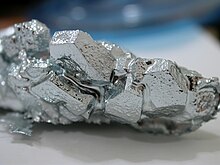
Gallium is a chemical element with the symbol Ga and atomic number 31. Discovered by French chemist Paul-Émile Lecoq de Boisbaudran in 1875,[vi] Gallium is in group thirteen of the periodic table and is similar to the other metals of the group (aluminium, indium, and thallium).
Elemental gallium is a soft, silvery metal in standard temperature and pressure. In its liquid state, it becomes silvery white. If likewise much force is applied, the gallium may fracture conchoidally. Since its discovery in 1875, gallium has widely been used to make alloys with low melting points. It is likewise used in semiconductors, as a dopant in semiconductor substrates.
The melting indicate of gallium is used equally a temperature reference signal. Gallium alloys are used in thermometers as a non-toxic and environmentally friendly alternative to mercury, and tin can withstand higher temperatures than mercury. An fifty-fifty lower melting point of −19 °C (−2 °F), well beneath the freezing point of h2o, is claimed for the alloy galinstan (62–95% gallium, 5–22% indium, and 0–16% tin by weight), but that may be the freezing point with the effect of supercooling.
Gallium does not occur equally a free element in nature, but as gallium(III) compounds in trace amounts in zinc ores (such equally sphalerite) and in bauxite. Elemental gallium is a liquid at temperatures greater than 29.76 °C (85.57 °F), and will melt in a person'southward easily at normal human torso temperature of 37.0 °C (98.vi °F).
Gallium is predominantly used in electronics. Gallium arsenide, the primary chemical chemical compound of gallium in electronics, is used in microwave circuits, high-speed switching circuits, and infrared circuits. Semiconducting gallium nitride and indium gallium nitride produce blue and violet lite-emitting diodes (LEDs) and diode lasers. Gallium is also used in the production of artificial gadolinium gallium garnet for jewelry. Gallium is considered a technology-disquisitional element by the United states National Library of Medicine and Frontiers Media.[7] [8]
Gallium has no known natural part in biology. Gallium(Iii) behaves in a similar manner to ferric salts in biological systems and has been used in some medical applications, including pharmaceuticals and radiopharmaceuticals.
Physical properties [edit]
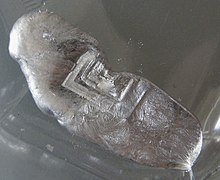
Crystallization of gallium from the melt
Elemental gallium is not establish in nature, but information technology is easily obtained by smelting. Very pure gallium is a silver blue metal that fractures conchoidally similar drinking glass. Gallium liquid expands past iii.10% when it solidifies; therefore, it should not exist stored in drinking glass or metallic containers because the container may rupture when the gallium changes state. Gallium shares the higher-density liquid country with a short listing of other materials that includes water, silicon, germanium, bismuth, and plutonium.[9]
Gallium attacks virtually other metals by diffusing into the metal lattice. For example, it diffuses into the grain boundaries of aluminium-zinc alloys[x] and steel,[11] making them very brittle. Gallium easily alloys with many metals, and is used in small quantities in the plutonium–gallium alloy in the plutonium cores of nuclear bombs to stabilize the plutonium crystal structure.[12]
The melting point of gallium, at 302.9146 K (29.7646 °C, 85.5763 °F), is simply in a higher place room temperature, and is approximately the same every bit the average summer daytime temperatures in Globe'south mid-latitudes. This melting point (mp) is i of the formal temperature reference points in the International Temperature Scale of 1990 (ITS-90) established by the International Agency of Weights and Measures (BIPM).[13] [14] [xv] The triple betoken of gallium, 302.9166 K (29.7666 °C, 85.5799 °F), is used by the Us National Institute of Standards and Engineering (NIST) in preference to the melting point.[16]
The melting point of gallium allows it to melt in the homo hand, and then solidify if removed. The liquid metal has a strong tendency to supercool below its melting betoken/freezing betoken: Ga nanoparticles can be kept in the liquid state below 90 Thousand.[17] Seeding with a crystal helps to initiate freezing. Gallium is i of the 4 non-radioactive metals (with caesium, rubidium, and mercury) that are known to be liquid at, or near, normal room temperature. Of the iv, gallium is the just 1 that is neither highly reactive (rubidium and caesium) nor highly toxic (mercury) and can, therefore, exist used in metal-in-drinking glass high-temperature thermometers. It is also notable for having one of the largest liquid ranges for a metal, and for having (unlike mercury) a depression vapor pressure at high temperatures. Gallium'south boiling point, 2673 Thou, is more than viii times higher than its melting point on the absolute scale, the greatest ratio between melting point and humid point of any element.[eighteen] Unlike mercury, liquid gallium metal wets drinking glass and skin, along with most other materials (with the exceptions of quartz, graphite, and Teflon)[ citation needed ], making it mechanically more than difficult to handle even though information technology is substantially less toxic and requires far fewer precautions. Gallium painted onto glass is a brilliant mirror.[19] For this reason as well equally the metal contamination and freezing-expansion issues, samples of gallium metallic are unremarkably supplied in polyethylene packets within other containers.
| Property | a | b | c |
|---|---|---|---|
| α (~25 °C, μm/yard) | 16 | 11 | 31 |
| ρ (29.seven °C, nΩ·one thousand) | 543 | 174 | 81 |
| ρ (0 °C, nΩ·m) | 480 | 154 | 71.6 |
| ρ (77 K, nΩ·m) | 101 | 30.8 | 14.3 |
| ρ (4.2 K, pΩ·m) | xiii.8 | 6.8 | one.6 |
Gallium does not crystallize in any of the simple crystal structures. The stable phase under normal conditions is orthorhombic with viii atoms in the conventional unit of measurement jail cell. Inside a unit of measurement cell, each atom has only 1 nearest neighbor (at a altitude of 244 pm). The remaining six unit cell neighbors are spaced 27, thirty and 39 pm further abroad, and they are grouped in pairs with the same distance.[21] Many stable and metastable phases are found as function of temperature and pressure.[22]
The bonding betwixt the two nearest neighbors is covalent; hence Ga2 dimers are seen as the fundamental building blocks of the crystal. This explains the low melting indicate relative to the neighbor elements, aluminium and indium. This structure is strikingly similar to that of iodine and may form considering of interactions betwixt the unmarried 4p electrons of gallium atoms, further away from the nucleus than the 4s electrons and the [Ar]3d10 cadre. This miracle recurs with mercury with its "pseudo-noble-gas" [Xe]4f145d106s2 electron configuration, which is liquid at room temperature.[23] The 3d10 electrons do not shield the outer electrons very well from the nucleus and hence the first ionisation energy of gallium is greater than that of aluminium.[ix] Gatwo dimers practise not persist in the liquid state and liquid gallium exhibits a complex low-coordinated structure in which each gallium cantlet is surrounded by x others, compared to values of xi-12 typical of most liquid metals.[24] [25]
The physical properties of gallium are highly anisotropic, i.e. have different values along the 3 major crystallographical axes a, b, and c (come across tabular array), producing a significant divergence betwixt the linear (α) and volume thermal expansion coefficients. The properties of gallium are strongly temperature-dependent, particularly about the melting point. For example, the coefficient of thermal expansion increases by several hundred percents upon melting.[20]
Isotopes [edit]
Gallium has 31 known isotopes, ranging in mass number from 56 to 86. But 2 isotopes are stable and occur naturally, gallium-69 and gallium-71. Gallium-69 is more arable: information technology makes upward about sixty.1% of natural gallium, while gallium-71 makes upwardly the remaining 39.9%. All the other isotopes are radioactive, with gallium-67 being the longest-lived (half-life three.261 days). Isotopes lighter than gallium-69 normally decay through beta plus decay (positron emission) or electron capture to isotopes of zinc, although the lightest few (with mass numbers 56 through 59) decay through prompt proton emission. Isotopes heavier than gallium-71 decay through beta minus decay (electron emission), maybe with delayed neutron emission, to isotopes of germanium, while gallium-70 can disuse through both beta minus decay and electron capture. Gallium-67 is unique among the light isotopes in having simply electron capture equally a decay mode, as its decay energy is non sufficient to allow positron emission.[26] Gallium-67 and gallium-68 (one-half-life 67.vii min) are both used in nuclear medicine.
Chemic backdrop [edit]
Gallium is found primarily in the +3 oxidation land. The +1 oxidation state is also found in some compounds, although information technology is less common than it is for gallium's heavier congeners indium and thallium. For example, the very stable GaCltwo contains both gallium(I) and gallium(Iii) and can be formulated equally GaIGa3Clfour; in contrast, the monochloride is unstable above 0 °C, disproportionating into elemental gallium and gallium(3) chloride. Compounds containing Ga–Ga bonds are true gallium(II) compounds, such every bit GaS (which can be formulated as Gaii 4+(S2−)2) and the dioxan complex Ga2Cl4(C4H8O2)ii.[27]
Aqueous chemistry [edit]
Potent acids dissolve gallium, forming gallium(III) salts such as Ga(NO
3 )
3 (gallium nitrate). Aqueous solutions of gallium(III) salts contain the hydrated gallium ion, [Ga(H
2 O)
half dozen ] 3+
.[28] : 1033 Gallium(Three) hydroxide, Ga(OH)
3 , may be precipitated from gallium(III) solutions by adding ammonia. Dehydrating Ga(OH)
three at 100 °C produces gallium oxide hydroxide, GaO(OH).[29] : 140–141
Alkaline hydroxide solutions dissolve gallium, forming gallate salts (not to be dislocated with identically named gallic acrid salts) containing the Ga(OH) −
four anion.[30] [28] : 1033 [31] Gallium hydroxide, which is amphoteric, as well dissolves in alkali to form gallate salts.[29] : 141 Although earlier work suggested Ga(OH) 3−
six as some other possible gallate anion,[32] it was not found in later work.[31]
Oxides and chalcogenides [edit]
Gallium reacts with the chalcogens simply at relatively loftier temperatures. At room temperature, gallium metal is not reactive with air and water because it forms a passive, protective oxide layer. At higher temperatures, even so, it reacts with atmospheric oxygen to form gallium(III) oxide, Ga
2 O
3 .[30] Reducing Ga
2 O
3 with elemental gallium in vacuum at 500 °C to 700 °C yields the night brown gallium(I) oxide, Ga
two O.[29] : 285 Ga
2 O is a very strong reducing amanuensis, capable of reducing H
2 And so
4 to H
2 S.[29] : 207 It disproportionates at 800 °C back to gallium and Ga
two O
three .[33]
Gallium(III) sulfide, Ga
ii S
3 , has three possible crystal modifications.[33] : 104 Information technology can be made by the reaction of gallium with hydrogen sulfide (H
ii S) at 950 °C.[29] : 162 Alternatively, Ga(OH)
3 can be used at 747 °C:[34]
- 2 Ga(OH)
3 + three H
2 S → Ga
2 S
three + vi H
2 O
Reacting a mixture of alkali metal carbonates and Ga
two O
3 with H
2 S leads to the formation of thiogallates containing the [Ga
ii S
4 ] 2−
anion. Potent acids decompose these salts, releasing H
2 S in the process.[33] : 104–105 The mercury salt, HgGa
two S
4 , can be used as a phosphor.[35]
Gallium also forms sulfides in lower oxidation states, such equally gallium(II) sulfide and the green gallium(I) sulfide, the latter of which is produced from the onetime by heating to 1000 °C under a stream of nitrogen.[33] : 94
The other binary chalcogenides, Ga
2 Se
3 and Ga
two Te
3 , accept the zincblende structure. They are all semiconductors but are easily hydrolysed and have limited utility.[33] : 104
Nitrides and pnictides [edit]


Gallium nitride (left) and gallium arsenide (right) wafers
Gallium reacts with ammonia at 1050 °C to grade gallium nitride, GaN. Gallium also forms binary compounds with phosphorus, arsenic, and antimony: gallium phosphide (GaP), gallium arsenide (GaAs), and gallium antimonide (GaSb). These compounds have the aforementioned structure equally ZnS, and have of import semiconducting properties.[28] : 1034 GaP, GaAs, and GaSb can be synthesized by the directly reaction of gallium with elemental phosphorus, arsenic, or antimony.[33] : 99 They exhibit higher electrical conductivity than GaN.[33] : 101 GaP tin can likewise be synthesized by reacting Ga
ii O with phosphorus at low temperatures.[36]
Gallium forms ternary nitrides; for example:[33] : 99
- Li
3 Ga + N
two → Li
3 GaN
2
Similar compounds with phosphorus and arsenic are possible: Li
3 GaP
ii and Li
iii GaAs
2 . These compounds are easily hydrolyzed by dilute acids and water.[33] : 101
Halides [edit]
Gallium(III) oxide reacts with fluorinating agents such every bit HF or F
2 to course gallium(III) fluoride, GaF
3 . It is an ionic chemical compound strongly insoluble in water. Nevertheless, it dissolves in hydrofluoric acid, in which information technology forms an adduct with water, GaF
iii ·3H
ii O. Attempting to dehydrate this adduct forms GaF
two OH·nH
2 O. The adduct reacts with ammonia to grade GaF
3 ·3NH
3 , which tin can then be heated to course anhydrous GaF
3 .[29] : 128–129
Gallium trichloride is formed by the reaction of gallium metal with chlorine gas.[30] Unlike the trifluoride, gallium(III) chloride exists equally dimeric molecules, Ga
2 Cl
vi , with a melting point of 78 °C. Eqivalent compounds are formed with bromine and iodine, Ga
2 Br
6 and Ga
two I
6 .[29] : 133
Similar the other group thirteen trihalides, gallium(III) halides are Lewis acids, reacting as halide acceptors with alkali metallic halides to class salts containing GaX −
4 anions, where 10 is a halogen. They likewise react with alkyl halides to form carbocations and GaX −
4 .[29] : 136–137
When heated to a high temperature, gallium(III) halides react with elemental gallium to form the respective gallium(I) halides. For example, GaCl
3 reacts with Ga to grade GaCl:
- 2 Ga + GaCl
3 ⇌ 3 GaCl (g)
At lower temperatures, the equilibrium shifts toward the left and GaCl disproportionates back to elemental gallium and GaCl
3 . GaCl can also be produced by reacting Ga with HCl at 950 °C; the product tin can be condensed every bit a red solid.[28] : 1036
Gallium(I) compounds can exist stabilized past forming adducts with Lewis acids. For example:
- GaCl + AlCl
3 → Ga +
[AlCl
4 ] −
The and so-called "gallium(2) halides", GaX
2 , are actually adducts of gallium(I) halides with the corresponding gallium(III) halides, having the structure Ga +
[GaX
4 ] −
. For example:[thirty] [28] : 1036 [37]
- GaCl + GaCl
3 → Ga +
[GaCl
4 ] −
Hydrides [edit]
Similar aluminium, gallium also forms a hydride, GaH
3 , known equally gallane, which may be produced by reacting lithium gallanate (LiGaH
4 ) with gallium(III) chloride at −xxx °C:[28] : 1031
- 3 LiGaH
4 + GaCl
3 → iii LiCl + 4 GaH
iii
In the presence of dimethyl ether as solvent, GaH
3 polymerizes to (GaH
3 )
n . If no solvent is used, the dimer Ga
ii H
6 (digallane) is formed as a gas. Its structure is similar to diborane, having two hydrogen atoms bridging the two gallium centers,[28] : 1031 different α-AlH
three in which aluminium has a coordination number of half dozen.[28] : 1008
Gallane is unstable above −10 °C, decomposing to elemental gallium and hydrogen.[38]
Organogallium compounds [edit]
Organogallium compounds are of similar reactivity to organoindium compounds, less reactive than organoaluminium compounds, but more reactive than organothallium compounds.[39] Alkylgalliums are monomeric. Lewis acidity decreases in the lodge Al > Ga > In and as a consequence organogallium compounds do not grade bridged dimers equally organoaluminum compounds do. Organogallium compounds are too less reactive than organoaluminum compounds. They do form stable peroxides.[40] These alkylgalliums are liquids at room temperature, having depression melting points, and are quite mobile and flammable. Triphenylgallium is monomeric in solution, only its crystals form concatenation structures due to weak intermolecluar Ga···C interactions.[39]
Gallium trichloride is a common starting reagent for the formation of organogallium compounds, such every bit in carbogallation reactions.[41] Gallium trichloride reacts with lithium cyclopentadienide in diethyl ether to class the trigonal planar gallium cyclopentadienyl complex GaCp3. Gallium(I) forms complexes with arene ligands such as hexamethylbenzene. Because this ligand is quite bulky, the structure of the [Ga(η6-Chalf dozenMe6)]+ is that of a half-sandwich. Less bulky ligands such every bit mesitylene allow 2 ligands to exist fastened to the primal gallium atom in a bent sandwich construction. Benzene is even less bulky and allows the formation of dimers: an example is [Ga(ηhalf dozen-C6Hhalf dozen)2] [GaCl4]·3C6H6.[39]
History [edit]
Small gallium aerosol fusing together
In 1871, the existence of gallium was get-go predicted past Russian chemist Dmitri Mendeleev, who named it "eka-aluminium" from its position in his periodic table. He also predicted several backdrop of eka-aluminium that correspond closely to the real backdrop of gallium, such as its density, melting point, oxide grapheme, and bonding in chloride.[42]
-
Comparison betwixt Mendeleev'due south 1871 predictions and the known properties of gallium[43] Property Mendeleev'southward predictions Actual properties Atomic weight ~68 69.723 Density 5.9 g/cm3 5.904 one thousand/cm3 Melting point Low 29.767 °C Formula of oxide 10002Othree Ga2Oiii Density of oxide five.5 g/cm3 v.88 g/cmthree Nature of hydroxide amphoteric amphoteric
Mendeleev farther predicted that eka-aluminium would be discovered by means of the spectroscope, and that metallic eka-aluminium would dissolve slowly in both acids and alkalis and would not react with air. He besides predicted that M2O3 would dissolve in acids to give MXiii salts, that eka-aluminium salts would form bones salts, that eka-aluminium sulfate should form alums, and that anhydrous MCl3 should have a greater volatility than ZnCl2: all of these predictions turned out to be truthful.[43]
Gallium was discovered using spectroscopy past French chemist Paul Emile Lecoq de Boisbaudran in 1875 from its characteristic spectrum (two violet lines) in a sample of sphalerite.[44] Later that year, Lecoq obtained the free metallic by electrolysis of the hydroxide in potassium hydroxide solution.[45]
He named the element "gallia", from Latin Gallia pregnant Gaul, after his native land of French republic. It was later claimed that, in a multilingual pun of a kind favoured past men of science in the 19th century, he had also named gallium after himself: "Le coq" is French for "the rooster" and the Latin word for "rooster" is "gallus". In an 1877 commodity, Lecoq denied this conjecture.[45]
Originally, de Boisbaudran determined the density of gallium as four.7 g/cmthree, the only property that failed to match Mendeleev's predictions; Mendeleev then wrote to him and suggested that he should remeasure the density, and de Boisbaudran then obtained the correct value of 5.9 g/cm3, that Mendeleev had predicted exactly.[43]
From its discovery in 1875 until the era of semiconductors, the primary uses of gallium were high-temperature thermometrics and metal alloys with unusual properties of stability or ease of melting (some such being liquid at room temperature).
The development of gallium arsenide every bit a direct bandgap semiconductor in the 1960s ushered in the nearly important phase in the applications of gallium.[xix] In 1978, the electronics industry used gallium to fabricate light emitting diodes, photovoltaics and semiconductors, while the metals business used it[46] to reduce the melting point of alloys.[47]
Occurrence [edit]
Gallium does not exist as a free chemical element in the Earth's crust, and the few high-content minerals, such as gallite (CuGaS2), are too rare to serve as a primary source.[48] The abundance in the World's crust is approximately 16.9 ppm.[49] This is comparable to the crustal abundances of lead, cobalt, and niobium. Yet unlike these elements, gallium does not course its own ore deposits with concentrations of > 0.1 wt.% in ore. Rather it occurs at trace concentrations like to the crustal value in zinc ores,[48] [fifty] and at somewhat higher values (~ l ppm) in aluminium ores, from both of which it is extracted as a by-product. This lack of contained deposits is due to gallium's geochemical behaviour, showing no stiff enrichment in the processes relevant to the formation of near ore deposits.[48]
The United states Geological Survey (USGS) estimates that more than 1 million tons of gallium is contained in known reserves of bauxite and zinc ores.[51] [52] Some coal flue dusts comprise pocket-size quantities of gallium, typically less than 1% by weight.[53] [54] [55] [56] All the same, these amounts are not extractable without mining of the host materials (see below). Thus, the availability of gallium is fundamentally determined by the rate at which bauxite, zinc ores (and coal) are extracted.
Production and availability [edit]

99.9999% (6N) gallium sealed in vacuum ampoule
Gallium is produced exclusively as a by-product during the processing of the ores of other metals. Its main source material is bauxite, the chief ore of aluminium, simply small amounts are also extracted from sulfidic zinc ores (sphalerite existence the primary host mineral).[57] [58] In the past, certain coals were an important source.
During the processing of bauxite to alumina in the Bayer process, gallium accumulates in the sodium hydroxide liquor. From this it tin exist extracted by a variety of methods. The most recent is the use of ion-exchange resin.[57] Achievable extraction efficiencies critically depend on the original concentration in the feed bauxite. At a typical feed concentration of 50 ppm, about 15% of the contained gallium is extractable.[57] The balance reports to the ruddy mud and aluminium hydroxide streams. Gallium is removed from the ion-substitution resin in solution. Electrolysis then gives gallium metallic. For semiconductor employ, it is further purified with zone melting or single-crystal extraction from a melt (Czochralski process). Purities of 99.9999% are routinely accomplished and commercially available.[59]

Its by-production condition ways that gallium production is constrained by the amount of bauxite, sulfidic zinc ores (and coal) extracted per yr. Therefore, its availability needs to exist discussed in terms of supply potential. The supply potential of a past-production is divers equally that amount which is economically extractable from its host materials per year nether current market weather (i.east. engineering science and cost).[60] Reserves and resource are non relevant for by-products, since they cannot be extracted independently from the master-products.[61] Recent estimates put the supply potential of gallium at a minimum of 2,100 t/yr from bauxite, 85 t/yr from sulfidic zinc ores, and potentially 590 t/yr from coal.[57] These figures are significantly greater than current product (375 t in 2016).[62] Thus, major future increases in the past-product production of gallium will be possible without significant increases in production costs or cost. The average toll in for low-grade gallium was $120 per kilogram in 2016 and $135–140 per kilogram in 2017.[63]
In 2017, the world's product of low-grade gallium was ca. 315 tons — an increase of xv% from 2016. China, Japan, South korea, Russia, and Ukraine were the leading producers, while Germany ceased chief production of gallium in 2016. The yield of loftier-purity gallium was ca. 180 tons, by and large originating from China, Japan, Slovakia, United kingdom and U.Due south. The 2017 earth annual production capacity was estimated at 730 tons for low-class and 320 tons for refined gallium.[63]
People's republic of china produced ca. 250 tons of low-class gallium in 2016 and ca. 300 tons in 2017. It also deemed for more half of global LED product.[63]
Applications [edit]
Semiconductor applications boss the commercial demand for gallium, accounting for 98% of the total. The next major application is for gadolinium gallium garnets.[64]
Semiconductors [edit]

Extremely high-purity (>99.9999%) gallium is commercially available to serve the semiconductor industry. Gallium arsenide (GaAs) and gallium nitride (GaN) used in electronic components represented about 98% of the gallium consumption in the United States in 2007. Almost 66% of semiconductor gallium is used in the U.S. in integrated circuits (mostly gallium arsenide), such every bit the manufacture of ultra-high-speed logic fries and MESFETs for low-dissonance microwave preamplifiers in cell phones. About twenty% of this gallium is used in optoelectronics.[51]
Worldwide, gallium arsenide makes upward 95% of the annual global gallium consumption.[59] Information technology amounted $7.5 billion in 2016, with 53% originating from jail cell phones, 27% from wireless communications, and the rest from automotive, consumer, fiber-optic, and military applications. The recent increase in GaAs consumption is by and large related to the emergence of 3G and 4G smartphones, which use 10 times more GaAs than older models.[63]
Gallium arsenide and gallium nitride can too exist plant in a diverseness of optoelectronic devices which had a market share of $15.iii billion in 2015 and $18.5 billion in 2016.[63] Aluminium gallium arsenide (AlGaAs) is used in high-power infrared laser diodes. The semiconductors gallium nitride and indium gallium nitride are used in blue and violet optoelectronic devices, mostly laser diodes and low-cal-emitting diodes. For instance, gallium nitride 405 nm diode lasers are used as a violet light source for higher-density Blu-ray Disc compact information disc drives.[65]
Other major application of gallium nitride are cablevision television transmission, commercial wireless infrastructure, power electronics, and satellites. The GaN radio frequency device market alone was estimated at $370 million in 2016 and $420 one thousand thousand in 2016.[63]
Multijunction photovoltaic cells, developed for satellite ability applications, are fabricated past molecular-beam epitaxy or metalorganic vapour-phase epitaxy of sparse films of gallium arsenide, indium gallium phosphide, or indium gallium arsenide. The Mars Exploration Rovers and several satellites use triple-junction gallium arsenide on germanium cells.[66] Gallium is too a component in photovoltaic compounds (such every bit copper indium gallium selenium sulfide Cu(In,Ga)(Se,S)2 ) used in solar panels every bit a cost-efficient alternative to crystalline silicon.[67]
Galinstan and other alloys [edit]
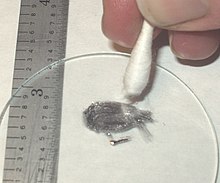
Galinstan hands wetting a piece of ordinary glass

Gallium readily alloys with most metals, and is used every bit an ingredient in low-melting alloys. The nearly eutectic blend of gallium, indium, and tin can is a room temperature liquid used in medical thermometers. This blend, with the merchandise-proper noun Galinstan (with the "-stan" referring to the tin, stannum in Latin), has a low freezing betoken of −19 °C (−2.two °F).[68] It has been suggested that this family unit of alloys could also exist used to cool reckoner chips in place of water, and is often used as a replacement for thermal paste in loftier-operation calculating.[69] [70] Gallium alloys take been evaluated as substitutes for mercury dental amalgams, but these materials have yet to encounter broad acceptance.
Because gallium wets glass or porcelain, gallium tin can be used to create brilliant mirrors. When the wetting activeness of gallium-alloys is not desired (as in Galinstan glass thermometers), the glass must exist protected with a transparent layer of gallium(Iii) oxide.[71]
The plutonium used in nuclear weapon pits is stabilized in the δ phase and made machinable by alloying with gallium.[72]
Biomedical applications [edit]
Although gallium has no natural role in biological science, gallium ions interact with processes in the torso in a manner like to iron(3). Because these processes include inflammation, a marking for many affliction states, several gallium salts are used (or are in development) as pharmaceuticals and radiopharmaceuticals in medicine. Interest in the anticancer properties of gallium emerged when information technology was discovered that 67Ga(III) citrate injected in tumor-begetting animals localized to sites of tumor. Clinical trials take shown gallium nitrate to have antineoplastic action confronting non-Hodgkin'south lymphoma and urothelial cancers. A new generation of gallium-ligand complexes such as tris(8-quinolinolato)gallium(III) (KP46) and gallium maltolate has emerged.[73] Gallium nitrate (brand proper noun Ganite) has been used as an intravenous pharmaceutical to treat hypercalcemia associated with tumor metastasis to bones. Gallium is idea to interfere with osteoclast part, and the therapy may be effective when other treatments have failed.[74] Gallium maltolate, an oral, highly absorbable grade of gallium(III) ion, is an anti-proliferative to pathologically proliferating cells, particularly cancer cells and some bacteria that accept it in place of ferric iron (Iron3+). Researchers are conducting clinical and preclinical trials on this chemical compound equally a potential handling for a number of cancers, infectious diseases, and inflammatory diseases.[75]
When gallium ions are mistakenly taken up in identify of iron(III) by bacteria such as Pseudomonas, the ions interfere with respiration, and the bacteria die. This happens because iron is redox-agile, allowing the transfer of electrons during respiration, while gallium is redox-inactive.[76] [77]
A complex amine-phenol Ga(III) compound MR045 is selectively toxic to parasites resistant to chloroquine, a common drug confronting malaria. Both the Ga(Iii) complex and chloroquine human action by inhibiting crystallization of hemozoin, a disposal product formed from the digestion of blood by the parasites.[78] [79]
Radiogallium salts [edit]
Gallium-67 salts such as gallium citrate and gallium nitrate are used equally radiopharmaceutical agents in the nuclear medicine imaging known as gallium browse. The radioactive isotope 67Ga is used, and the compound or salt of gallium is unimportant. The body handles Gaiii+ in many means equally though it were Feiii+, and the ion is jump (and concentrates) in areas of inflammation, such equally infection, and in areas of rapid cell sectionalisation. This allows such sites to be imaged past nuclear scan techniques.[eighty]
Gallium-68, a positron emitter with a half-life of 68 min, is now used as a diagnostic radionuclide in PET-CT when linked to pharmaceutical preparations such as DOTATOC, a somatostatin analogue used for neuroendocrine tumors investigation, and DOTA-TATE, a newer one, used for neuroendocrine metastasis and lung neuroendocrine cancer, such equally certain types of microcytoma. Gallium-68's training every bit a pharmaceutical is chemical, and the radionuclide is extracted past elution from germanium-68, a constructed radioisotope of germanium, in gallium-68 generators.[81]
Other uses [edit]
Gallium is used for neutrino detection. Possibly the largest amount of pure gallium ever collected in a single spot is the Gallium-Germanium Neutrino Telescope used by the SAGE experiment at the Baksan Neutrino Observatory in Russia. This detector contains 55–57 tonnes (~9 cubic metres) of liquid gallium.[82] Some other experiment was the GALLEX neutrino detector operated in the early on 1990s in an Italian mountain tunnel. The detector contained 12.two tons of watered gallium-71. Solar neutrinos acquired a few atoms of 71Ga to become radioactive 71Ge, which were detected. This experiment showed that the solar neutrino flux is forty% less than theory predicted. This deficit was not explained until better solar neutrino detectors and theories were constructed (see SNO).[83]
Gallium is also used as a liquid metal ion source for a focused ion beam. For example, a focused gallium-ion beam was used to create the globe's smallest book, Teeny Ted from Turnip Town.[84] Another use of gallium is as an additive in glide wax for skis, and other low-friction surface materials.[85]
A well-known practical joke among chemists is to fashion gallium spoons and utilise them to serve tea to unsuspecting guests, since gallium has a similar appearance to its lighter homolog aluminium. The spoons then melt in the hot tea.[86]
Gallium in the ocean [edit]
Advances in trace element testing accept immune scientists to discover traces of dissolved gallium in the Atlantic and Pacific Oceans [87] In recent years, dissolved gallium concentrations have presented in the Beaufort Bounding main.[87] [88] These reports reflect the possible profiles of the Pacific and Atlantic Ocean waters.[88] For the Pacific Oceans, typical dissolved gallium concentrations are betwixt 4–half dozen pmol/kg at depths <~150 m. In comparing, for Atlantic waters 25–28 pmol/kg at depths >~350 g.[88]
Gallium has entered our oceans mainly through aeolian input, but having gallium in our oceans can be used to resolve aluminum distribution in the oceans.[89] The reason for this is that gallium is geochemically similar to aluminum, simply less reactive. Gallium also has a slightly larger surface h2o residence time than aluminum.[89] Gallium has a similar dissolved contour like to that of aluminum, due to this gallium can be used as a tracer for aluminum.[89] Gallium can also be used as a tracer of aeolian inputs of fe.[90] Gallium is used as a tracer for fe in the northwest Pacific, south and central Atlantic Oceans.[90] For example, in the northwest Pacific, depression gallium surface waters, in the subpolar region suggest that there is low dust input, which can subsequently explain the following high-food, low-chlorophyll ecology behavior.[90]
Precautions [edit]
| Hazards | |
|---|---|
| GHS labelling: | |
| Pictograms |  |
| Signal word | Danger |
| Adventure statements | H290, H318 |
| Precautionary statements | P280, P305, P310, P338, P351 [91] |
| NFPA 704 (fire diamond) | [92] 1 0 0 |

Metallic gallium is not toxic. However, exposure to gallium halide complexes tin can result in acute toxicity.[93] The Ga3+ ion of soluble gallium salts tends to form the insoluble hydroxide when injected in large doses; precipitation of this hydroxide resulted in nephrotoxicity in animals. In lower doses, soluble gallium is tolerated well and does not accrue equally a poison, instead being excreted mostly through urine. Excretion of gallium occurs in two phases: the first stage has a biological one-half-life of 1 hour, while the second has a biological half-life of 25 hours.[80]
References [edit]
- ^ "Standard Atomic Weights: Gallium". CIAAW. 1987.
- ^ a b Zhang Y; Evans JRG; Zhang S (2011). "Corrected Values for Boiling Points and Enthalpies of Vaporization of Elements in Handbooks". J. Chem. Eng. Data. 56 (2): 328–337. doi:10.1021/je1011086.
- ^ Ga(−3) has been observed in LaGa, see Dürr, Ines; Bauer, Britta; Röhr, Caroline (2011). "Lanthan-Triel/Tetrel-ide La(Al,Ga) x (Si,Ge)1-ten . Experimentelle und theoretische Studien zur Stabilität intermetallischer one:1-Phasen" (PDF). Z. Naturforsch. (in German). 66b: 1107–1121.
- ^ Hofmann, Patrick (1997). Colture. Ein Programm zur interaktiven Visualisierung von Festkörperstrukturen sowie Synthese, Struktur und Eigenschaften von binären und ternären Alkali- und Erdalkalimetallgalliden (PDF) (Thesis) (in German). PhD Thesis, ETH Zurich. p. 72. doi:10.3929/ethz-a-001859893. hdl:20.500.11850/143357. ISBN978-3728125972.
- ^ Weast, Robert (1984). CRC, Handbook of Chemistry and Physics. Boca Raton, Florida: Chemical Prophylactic Company Publishing. pp. E110. ISBN0-8493-0464-4.
- ^ Scerri, Eric (2020). The Periodic Table: Its Story and Its Significance. Oxford Academy Press. p. 149. ISBN978-0-xix-091436-3.
- ^ Cobelo-García, A.; Filella, One thousand.; Croot, P.; Frazzoli, C.; Du Laing, G.; Ospina-Alvarez, N.; Rauch, Southward.; Salaun, P.; Schäfer, J.; Zimmermann, S. (2015). "Price action TD1407: network on technology-critical elements (Discover)—from environmental processes to human being wellness threats". Ecology Science and Pollution Research International. 22 (19): 15188–15194. doi:10.1007/s11356-015-5221-0. ISSN 0944-1344. PMC4592495. PMID 26286804.
- ^ Romero-Freire, Ana; Santos-Echeandía, Juan; Neira, Patricia; Cobelo-García, Antonio (2019). "Less-Studied Technology-Critical Elements (Nb, Ta, Ga, In, Ge, Te) in the Marine Environs: Review on Their Concentrations in Water and Organisms". Frontiers in Marine Scientific discipline. 6. doi:x.3389/fmars.2019.00532. ISSN 2296-7745.
- ^ a b Greenwood and Earnshaw, p. 222
- ^ Tsai, Due west. 50; Hwu, Y.; Chen, C. H.; Chang, L. W.; Je, J. H.; Lin, H. G.; Margaritondo, G. (2003). "Grain boundary imaging, gallium diffusion and the fracture behavior of Al–Zn Blend – An in situ study". Nuclear Instruments and Methods in Physics Enquiry Section B. 199: 457–463. Bibcode:2003NIMPB.199..457T. doi:10.1016/S0168-583X(02)01533-ane.
- ^ Vigilante, G. N.; Trolano, E.; Mossey, C. (June 1999). "Liquid Metal Embrittlement of ASTM A723 Gun Steel by Indium and Gallium". Defense Technical Data Center. Retrieved 2009-07-07 .
- ^ Sublette, Cary (2001-09-09). "Section six.2.2.1". Nuclear Weapons FAQ . Retrieved 2008-01-24 .
- ^ Preston–Thomas, H. (1990). "The International Temperature Calibration of 1990 (ITS-90)" (PDF). Metrologia. 27 (1): 3–10. Bibcode:1990Metro..27....3P. doi:10.1088/0026-1394/27/i/002.
- ^ "ITS-xc documents at Bureau International de Poids et Mesures".
- ^ Magnum, B. West.; Furukawa, G. T. (August 1990). "Guidelines for Realizing the International Temperature Scale of 1990 (ITS-90)" (PDF). National Institute of Standards and Technology. NIST TN 1265. Archived from the original (PDF) on 2003-07-04.
- ^ Strouse, Gregory F. (1999). "NIST realization of the gallium triple point". Proc. TEMPMEKO. 1999 (1): 147–152. Retrieved 2016-10-xxx .
- ^ Parravicini, G. B.; Stella, A.; Ghigna, P.; Spinolo, G.; Migliori, A.; d'Acapito, F.; Kofman, R. (2006). "Extreme undercooling (downwards to 90K) of liquid metal nanoparticles". Applied Physics Letters. 89 (iii): 033123. Bibcode:2006ApPhL..89c3123P. doi:x.1063/ane.2221395.
- ^ Greenwood and Earnshaw, p. 224
- ^ a b Greenwood and Earnshaw, p. 221
- ^ a b Rosebury, Fred (1992). Handbook of Electron Tube and Vacuum Techniques. Springer. p. 26. ISBN978-one-56396-121-ii.
- ^ Bernascino, M.; et al. (1995). "Ab initio calculations of structural and electronic properties of gallium solid-land phases". Phys. Rev. B. 52 (14): 9988–9998. Bibcode:1995PhRvB..52.9988B. doi:10.1103/PhysRevB.52.9988. PMID 9980044.
- ^ "Phase Diagrams of the Elements", David A. Young, UCRL-51902 "Prepared for the U.Due south. Energy Research & Development Administration under contract No. Westward-7405-Eng-48". (1975)
- ^ Greenwood and Earnshaw, p. 223
- ^ Yagafarov, O. F.; Katayama, Y.; Brazhkin, Five. Five.; Lyapin, A. G.; Saitoh, H. (November vii, 2012). "Free energy dispersive x-ray diffraction and reverse Monte Carlo structural study of liquid gallium under pressure level". Physical Review B. 86 (17): 174103. Bibcode:2012PhRvB..86q4103Y. doi:10.1103/PhysRevB.86.174103 – via APS.
- ^ Drewitt, James West. E.; Turci, Francesco; Heinen, Benedict J.; Macleod, Simon G.; Qin, Fei; Kleppe, Annette Grand.; Lord, Oliver T. (Apr nine, 2020). "Structural Ordering in Liquid Gallium under Extreme Conditions". Physical Review Letters. 124 (14): 145501. Bibcode:2020PhRvL.124n5501D. doi:10.1103/PhysRevLett.124.145501. PMID 32338984. S2CID 216177238 – via DOI.org (Crossref).
- ^ Audi, Georges; Bersillon, Olivier; Blachot, Jean; Wapstra, Aaldert Hendrik (2003), "The NUBASE evaluation of nuclear and decay properties", Nuclear Physics A, 729: three–128, Bibcode:2003NuPhA.729....3A, doi:10.1016/j.nuclphysa.2003.xi.001
- ^ Greenwood and Earnshaw, p. 240
- ^ a b c d e f g h Wiberg, Egon; Wiberg, Nils; Holleman, Arnold Frederick (2001). Inorganic chemistry. Academic Press. ISBN978-0-12-352651-ix.
- ^ a b c d e f one thousand h Downs, Anthony John (1993). Chemistry of aluminium, gallium, indium, and thallium. Springer. ISBN978-0-7514-0103-5.
- ^ a b c d Eagleson, Mary, ed. (1994). Curtailed encyclopedia chemistry . Walter de Gruyter. p. 438. ISBN978-3-11-011451-five.
- ^ a b Sipos, P. L.; Megyes, T. N.; Berkesi, O. (2008). "The Construction of Gallium in Strongly Alkaline, Highly Full-bodied Gallate Solutions—a Raman and 71
Ga
-NMR Spectroscopic Written report". J Solution Chem. 37 (ten): 1411–1418. doi:10.1007/s10953-008-9314-y. S2CID 95723025. - ^ Hampson, Due north. A. (1971). Harold Reginald Thirsk (ed.). Electrochemistry—Volume three: Specialist periodical report. Keen Uk: Royal Society of Chemistry. p. 71. ISBN978-0-85186-027-five.
- ^ a b c d east f g h i Greenwood, N. Due north. (1962). Harry Julius Emeléus; Alan Thousand. Sharpe (eds.). Advances in inorganic chemistry and radiochemistry. Vol. five. Academic Press. pp. 94–95. ISBN978-0-12-023605-three.
- ^ Madelung, Otfried (2004). Semiconductors: data handbook (3rd ed.). Birkhäuser. pp. 276–277. ISBN978-3-540-40488-0.
- ^ Krausbauer, 50.; Nitsche, R.; Wild, P. (1965). "Mercury gallium sulfide, HgGa
2 S
4 , a new phosphor". Physica. 31 (1): 113–121. Bibcode:1965Phy....31..113K. doi:10.1016/0031-8914(65)90110-2. - ^ Michelle Davidson (2006). Inorganic Chemistry. Lotus Printing. p. 90. ISBN978-81-89093-39-6.
- ^ Arora, Amit (2005). Text Volume Of Inorganic Chemistry. Discovery Publishing House. pp. 389–399. ISBN978-81-8356-013-9.
- ^ Downs, Anthony J.; Pulham, Colin R. (1994). Sykes, A. G. (ed.). Advances in Inorganic Chemistry. Vol. 41. Bookish Press. pp. 198–199. ISBN978-0-12-023641-1.
- ^ a b c Greenwoood and Earnshaw, pp. 262–five
- ^ Uhl, West. and Halvagar, G. R.; et al. (2009). "Reducing Ga-H and Ga-C Bonds in Close Proximity to Oxidizing Peroxo Groups: Conflicting Properties in Single Molecules". Chemistry: A European Journal. 15 (42): 11298–11306. doi:x.1002/chem.200900746. PMID 19780106.
{{cite periodical}}: CS1 maint: multiple names: authors list (link) - ^ Amemiya, Ryo (2005). "GaCliii in Organic Synthesis". European Periodical of Organic Chemistry. 2005 (24): 5145–5150. doi:10.1002/ejoc.200500512.
- ^ Ball, Philip (2002). The Ingredients: A Guided Tour of the Elements. Oxford University Press. p. 105. ISBN978-0-19-284100-ane.
- ^ a b c Greenwood and Earnshaw, p. 217.
- ^ Lecoq de Boisbaudran, Paul Émile (1875). "Caractères chimiques et spectroscopiques d'united nations nouveau métal, le gallium, découvert dans une blende de la mine de Pierrefitte, vallée d'Argelès (Pyrénées)". Comptes Rendus Hebdomadaires des Séances de 50'Académie des Sciences. 81: 493–495.
- ^ a b Weeks, Mary Elvira (1932). "The discovery of the elements. XIII. Some elements predicted by Mendeleeff". Journal of Chemic Instruction. ix (nine): 1605–1619. Bibcode:1932JChEd...9.1605W. doi:ten.1021/ed009p1605.
- ^ Petkof, Benjamin (1978). "Gallium" (PDF). GPO. USGS Minerals Yearbook.
- ^ "An Overview of Gallium". AZoNetwork. 18 December 2001.
- ^ a b c Frenzel, Max (2016). "The distribution of gallium, germanium and indium in conventional and non-conventional resources – Implications for global availability (PDF Download Available)". ResearchGate. doi:10.13140/rg.2.two.20956.18564. Retrieved 2017-06-02 .
- ^ Burton, J. D.; Culkin, F.; Riley, J. P. (2007). "The abundances of gallium and germanium in terrestrial materials". Geochimica et Cosmochimica Acta. 16 (i): 151–180. Bibcode:1959GeCoA..xvi..151B. doi:10.1016/0016-7037(59)90052-iii.
- ^ Frenzel, Max; Hirsch, Tamino; Gutzmer, Jens (July 2016). "Gallium, germanium, indium, and other trace and small elements in sphalerite as a function of deposit type — A meta-analysis". Ore Geology Reviews. 76: 52–78. doi:x.1016/j.oregeorev.2015.12.017.
- ^ a b Kramer, Deborah A. "Mineral Commodity Summary 2006: Gallium" (PDF). The states Geological Survey. Retrieved 2008-eleven-20 .
- ^ Kramer, Deborah A. "Mineral Yearbook 2006: Gallium" (PDF). U.s. Geological Survey. Retrieved 2008-11-xx .
- ^ Xiao-quan, Shan; Wen, Wang & Bei, Wen (1992). "Determination of gallium in coal and coal fly ash by electrothermal atomic absorption spectrometry using slurry sampling and nickel chemical modification". Journal of Analytical Atomic Spectrometry. 7 (v): 761. doi:10.1039/JA9920700761.
- ^ "Gallium in West Virginia Coals". West Virginia Geological and Economic Survey. 2002-03-02.
- ^ Font, O; Querol, Xavier; Juan, Roberto; Casado, Raquel; Ruiz, Carmen R.; López-Soler, Ángel; Coca, Pilar; Peña, Francisco García (2007). "Recovery of gallium and vanadium from gasification fly ash". Periodical of Hazardous Materials. 139 (iii): 413–23. doi:10.1016/j.jhazmat.2006.02.041. PMID 16600480.
- ^ Headlee, A. J. Due west. & Hunter, Richard G. (1953). "Elements in Coal Ash and Their Industrial Significance". Industrial and Engineering Chemistry. 45 (three): 548–551. doi:10.1021/ie50519a028.
- ^ a b c d Frenzel, Max; Ketris, Marina P.; Seifert, Thomas; Gutzmer, Jens (March 2016). "On the current and hereafter availability of gallium". Resources Policy. 47: 38–l. doi:10.1016/j.resourpol.2015.11.005.
- ^ Frenzel, Max; Hirsch, Tamino; Gutzmer, Jens (2016). "Gallium, germanium, indium, and other trace and small-scale elements in sphalerite as a office of deposit type — A meta-analysis". Ore Geology Reviews. 76: 52–78. doi:10.1016/j.oregeorev.2015.12.017. ISSN 0169-1368.
- ^ a b Moskalyk, R. R. (2003). "Gallium: the backbone of the electronics manufacture". Minerals Engineering. xvi (ten): 921–929. doi:10.1016/j.mineng.2003.08.003.
- ^ Frenzel, M; Tolosana-Delgado, R; Gutzmer, J (2015). "Assessing the supply potential of loftier-tech metals – A general method". Resources Policy. 46: 45–58. doi:10.1016/j.resourpol.2015.08.002.
- ^ Frenzel, Max; Mikolajczak, Claire; Reuter, Markus A.; Gutzmer, Jens (June 2017). "Quantifying the relative availability of high-tech by-product metals – The cases of gallium, germanium and indium". Resource Policy. 52: 327–335. doi:ten.1016/j.resourpol.2017.04.008.
- ^ Gallium – In: USGS Mineral Article Summaries (PDF). United States Geological Survey. 2017.
- ^ a b c d due east f Galium. USGS (2018)
- ^ Greber, J. F. (2012) "Gallium and Gallium Compounds" in Ullmann's Encyclopedia of Industrial Chemistry, Wiley-VCH, Weinheim, doi:10.1002/14356007.a12_163.
- ^ Coleman, James J.; Jagadish, Chennupati; Catrina Bryce, A. (2012-05-02). Advances in Semiconductor Lasers. pp. 150–151. ISBN978-0-12-391066-0.
- ^ Crisp, D.; Pathare, A.; Ewell, R. C. (2004). "The performance of gallium arsenide/germanium solar cells at the Martian surface". Acta Astronautica. 54 (ii): 83–101. Bibcode:2004AcAau..54...83C. doi:10.1016/S0094-5765(02)00287-4.
- ^ Alberts, V.; Titus J.; Birkmire R. W. (2003). "Textile and device properties of unmarried-phase Cu(In,Ga)(Se,South)ii alloys prepared by selenization/sulfurization of metallic alloys". Thin Solid Films. 451–452: 207–211. Bibcode:2004TSF...451..207A. doi:10.1016/j.tsf.2003.10.092.
- ^ Surmann, P; Zeyat, H (Nov 2005). "Voltammetric analysis using a self-renewable non-mercury electrode". Belittling and Bioanalytical Chemistry. 383 (vi): 1009–13. doi:x.1007/s00216-005-0069-7. ISSN 1618-2642. PMID 16228199. S2CID 22732411.
- ^ Knight, Will (2005-05-05). "Hot chips chilled with liquid metal". Archived from the original on 2007-02-11. Retrieved 2008-eleven-xx .
- ^ Martin, Yves. "High Performance Liquid Metal Thermal Interface for Large Volume Production" (PDF).
- ^ United states of america. Office of Naval Research. Committee on the Bones Properties of Liquid Metals, U.S. Atomic Energy Committee (1954). Liquid-metals handbook. U.Southward. Govt. Impress. Off. p. 128.
- ^ Besmann, Theodore 1000. (2005). "Thermochemical Behavior of Gallium in Weapons-Material-Derived Mixed-Oxide Light H2o Reactor (LWR) Fuel". Journal of the American Ceramic Lodge. 81 (12): 3071–3076. doi:10.1111/j.1151-2916.1998.tb02740.x.
- ^ Chitambar, Christopher R. (2018). "Chapter 10. Gallium Complexes every bit Anticancer drugs". In Sigel, Astrid; Sigel, Helmut; Freisinger, Eva; Sigel, Roland K. O. (eds.). Metallo-Drugs: Development and Activity of Anticancer Agents. Metal Ions in Life Sciences. Vol. 18. Berlin: de Gruyter GmbH. pp. 281–301. doi:10.1515/9783110470734-016. ISBN9783110470734. PMID 29394029.
- ^ "gallium nitrate". Archived from the original on 2009-06-08. Retrieved 2009-07-07 .
- ^ Bernstein, L. R.; Tanner, T.; Godfrey, C. & Noll, B. (2000). "Chemistry and Pharmacokinetics of Gallium Maltolate, a Compound With High Oral Gallium Bioavailability". Metal-Based Drugs. 7 (1): 33–47. doi:x.1155/MBD.2000.33. PMC2365198. PMID 18475921.
- ^ "A Trojan-horse strategy selected to fight bacteria". INFOniac.com. 2007-03-16. Retrieved 2008-xi-twenty .
- ^ Smith, Michael (2007-03-xvi). "Gallium May Have Antibiotic-Similar Properties". MedPage Today. Retrieved 2008-11-20 .
- ^ Goldberg D. Due east.; Sharma V.; Oksman A.; Gluzman I. Y.; Wellems T. E.; Piwnica-Worms D. (1997). "Probing the chloroquine resistance locus of Plasmodium falciparum with a novel class of multidentate metallic(III) coordination complexes". J. Biol. Chem. 272 (10): 6567–72. doi:10.1074/jbc.272.10.6567. PMID 9045684. S2CID 3408513.
- ^ British indian ocean territory, Christophe; Swoop, Daniel (2010). "Bioorganometallic Chemistry and Malaria". Medicinal Organometallic Chemistry. Topics in Organometallic Chemistry. Vol. 32. p. 155. doi:10.1007/978-three-642-13185-1_7. ISBN978-3-642-13184-four. S2CID 85940061.
- ^ a b Nordberg, Gunnar F.; Fowler, Bruce A.; Nordberg, Monica (vii August 2014). Handbook on the Toxicology of Metals (fourth ed.). Bookish Press. pp. 788–xc. ISBN978-0-12-397339-9.
- ^ Banerjee, Sangeeta Ray; Pomper, Martin G. (June 2013). "Clinical Applications of Gallium-68". Appl. Radiat. Isot. 76: 2–13. doi:10.1016/j.apradiso.2013.01.039. PMC3664132. PMID 23522791.
- ^ "Russian American Gallium Experiment". 2001-10-19. Archived from the original on 2010-07-05. Retrieved 2009-06-24 .
- ^ "Neutrino Detectors Experiments: GALLEX". 1999-06-26. Retrieved 2008-eleven-20 .
- ^ "Nano lab produces world's smallest book" Archived 2015-10-13 at the Wayback Motorcar. Simon Fraser University. 11 Apr 2007. Retrieved 31 January 2013.
- ^ US 5069803, Sugimura, Kentaro; Hasimoto, Shoji & Ono, Takayuki, "Use of a synthetic resin limerick containing gallium particles in the glide surfacing material of skis and other applications", issued 1995
- ^ Kean, Sam (2010). The Disappearing Spoon: And Other True Tales of Madness, Love, and the History of the World from the Periodic Table of the Elements . Boston: Lilliputian, Brown and Company. ISBN978-0-316-05164-4.
- ^ a b Orians, K. J.; Bruland, K. W. (Apr 1988). "Dissolved Gallium in the Open Ocean". Nature. 332 (21): 717–nineteen. Bibcode:1988Natur.332..717O. doi:ten.1038/332717a0. S2CID 4323435.
- ^ a b c McAlister, Jason A.; Orians, Kristin J. (20 Dec 2015). "Dissolved Gallium in the Beaufort Bounding main of the Western Chill Ocean: A GEOTRACES cruise in the International Polar Yr". Marine Chemical science. 177 (Part ane): 101–109. doi:10.1016/j.marchem.2015.05.007. Retrieved 29 August 2021 – via ScienceDirect.
- ^ a b c Shiller, A. M. (June 1998). "Dissolved Gallium in the Atlantic Bounding main". Marine Chemistry. 61 (1): 87–99. doi:10.1016/S0304-4203(98)00009-7.
- ^ a b c Shiller, A. M.; Bairamadgi, G. R. (August 2006). "Dissolved Gallium in the northwest Pacific and the south and central Atlantic Oceans: Implications for aeolian Fe input and reconsideration of Profiles". Geochemistry, Geophysics, Geosystems. vii (8): n/a. Bibcode:2006GGG.....7.8M09S. doi:10.1029/2005GC001118.
- ^ "Gallium 203319". Sigma Aldrich.
- ^ "MSDS – 203319". Sigma Aldrich.
- ^ Ivanoff, C. South.; Ivanoff, A. Eastward.; Hottel, T. Fifty. (February 2012). "Gallium poisoning: a rare case study". Food Chem. Toxicol. fifty (two): 212–5. doi:10.1016/j.fct.2011.x.041. PMID 22024274.
Bibliography [edit]
- Greenwood, Norman North.; Earnshaw, Alan (1997). Chemical science of the Elements (2d ed.). Butterworth-Heinemann. ISBN978-0-08-037941-8.
External links [edit]
- Gallium at The Periodic Table of Videos (Academy of Nottingham)
- Safety data sheet at acialloys.com
- High-resolution photographs of molten gallium, gallium crystals and gallium ingots under Creative Commons licence
- – textbook information regarding gallium
- Environmental effects of gallium
- [httpd://minerals.usgs.gov/minerals/pubs/commodity/gallium/460798.pdf Toll development of gallium 1959–1998]
- Gallium: A Smart Metallic United States Geological Survey
- Technology produces hydrogen by calculation h2o to an alloy of aluminum and gallium
- Thermal conductivity
- Physical and thermodynamical properties of liquid gallium (doc pdf)
collinsimpeartale1949.blogspot.com
Source: https://en.wikipedia.org/wiki/Gallium
0 Response to "How to Return Gallium Into a Solid Again"
Post a Comment